


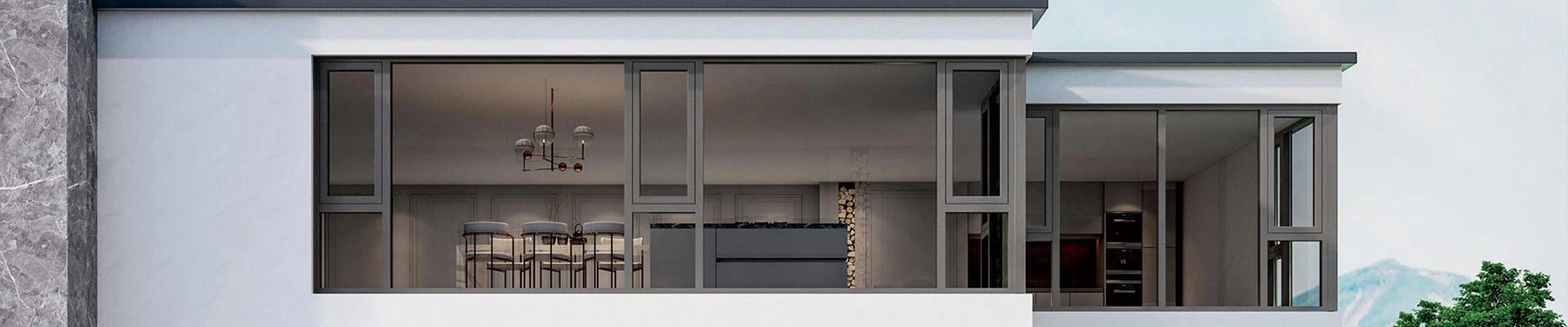
Windows are where most buildings lose heat in winter and gain it in summer. SKATE energy efficient windows combine thermal break frames with Low-E, argon-filled double or triple glazing, so you can heat and cool your rooms with less energy.
Glass Does Most of the Work
Glass makes up around 85% of a window's area, so the glass unit decides most of its energy performance.
- Low-E coating reflects heat back into the room in winter and blocks solar heat in summer.
- Argon gas in the cavity insulates better than air.
- Triple glazing (for example 5+22A+5+22A+5 on our 95 Passive series) adds a second cavity for cold climates. Our 90 series with Low-E triple glazing tested at a whole-window U-value of 0.9 W/m²K - grade 10, the top class of GB/T 31433.
- Warm-edge spacers reduce heat loss at the glass edge.
- Solar control - our W110 passive window tested at SHGC 0.26, blocking most solar heat in summer.
We use soft-coat Low-E glass from Xinyi Glass. Our supplier's argon-filled insulating glass units (6 Low-E + 12Ar + 6) meet ASTM E2190-19 and Australia's AS 4666 for fogging, dew point and argon retention.
Seal the Gaps, Not Just the Glass
Energy is also lost through air leaks. Three seal lines, a 12 mm sash overlap and one-piece bent gaskets (no cut corners) keep drafts out.
HTI Nano Heat-Insulating Glass
For sunny climates, our HTI nano heat-insulating glass keeps rooms bright while blocking solar heat. A 6 mm pane tested at 69% visible light transmittance but only 36% direct solar transmittance, with a shading coefficient of 0.58 (report BETC-QC1-2021-00965).
FAQ
Q1: Are your windows NFRC or ENERGY STAR certified?
A: We can provide test reports for U-value and air leakage; please contact us for the report for your chosen series.]
Q2: Is triple glazing worth it?
A: In cold climates, and for bedrooms facing noise, triple glazing usually pays back through lower heating bills and better comfort. In mild climates, double Low-E glass is often enough.