


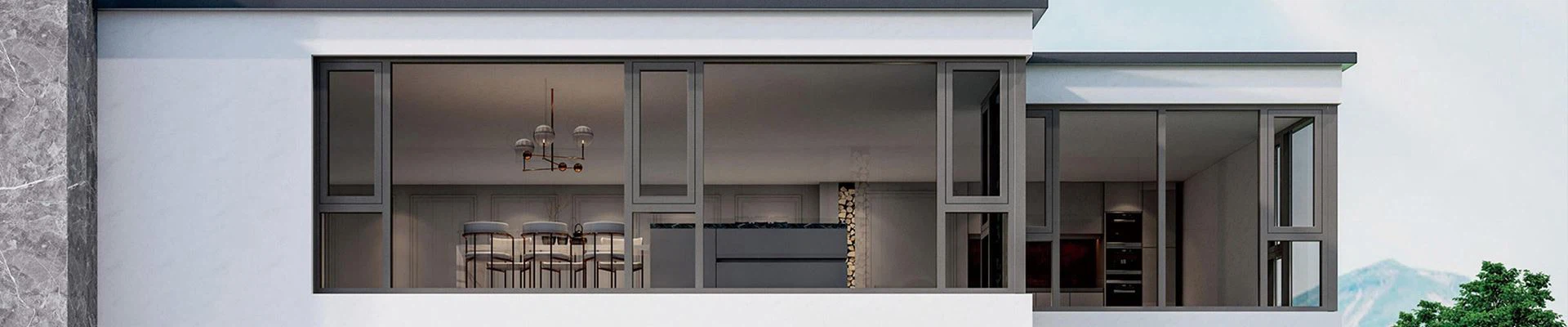
Traffic, trains, aircraft and nightlife noise all reach a room through its windows. SKATE soundproof windows reduce outside noise with laminated insulating glass, three seal lines and tight, precision-machined joints.
Why Some Windows Let Noise In
Sound travels as vibration and through air gaps. Most standard windows have only one or two seals. Thin, single-type glass vibrates easily and passes sound through.
How SKATE Windows Block Noise
Three seal lines
against one or two on most standard windows.
01
12 mm sash overlap
about twice that of ordinary thermal break windows, closing the path sound takes around the sash.
02
One-piece bent gaskets
no cut and welded corners where air can leak.
03
Laminated insulating glass
the PVB interlayer damps vibration; argon in the cavity adds further insulation.
04
Asymmetric glass
different pane thicknesses stop the panes from resonating at the same frequency.
05
How Much Quieter?
Tested to GB/T 8485-2008 at national test centers:
|
Series |
Glass |
Sound insulation |
|
90 Casement |
Low-E triple glazing (5 Low-E + 12A + 5 + 12A + 5 Low-E) |
Rw 44 dB (C −2; Ctr −6) |
|
75 Tilt & Turn |
Laminated triple glazing (…+ 5 + 0.76 PVB + 5) |
Rw 40 dB (C −1; Ctr −5) |
|
95 Casement |
Triple double-silver Low-E |
Rw 37 dB |
|
W110 Passive |
Triple double-silver Low-E |
Rw 36 dB |
Three panes, three seal lines and a 90 mm frame make the difference. The result in a finished room also depends on the walls, doors and installation.
Recommended Systems


FAQ
Q1: Which glass is best for soundproofing?
A: Argon-filled insulating glass with a laminated pane. Laminated glass damps vibration better than thicker single panes.
Q2: Can I soundproof just one room?
A: Yes. Many homeowners start with bedrooms facing the street. We make each window to size, so you can replace one room at a time.
Q3: How much quieter will my room be?
A: In laboratory tests to GB/T 8485-2008, our 90 series casement with Low-E triple glazing reached Rw 44 dB, and our 75 tilt and turn window with laminated triple glazing reached Rw 40 dB. Real-world results also depend on the wall and the installation.
Q4: Why do you use glass panes of different thicknesses?
A: Panes of the same thickness resonate at the same frequency and let that sound through. Asymmetric glass, with panes of different thickness, breaks up the resonance and improves sound insulation.
Q5: Does the frame matter as much as the glass?
A: Yes. Sound passes through any air gap. Three seal lines, a 12 mm sash overlap, one-piece gaskets and precision-machined joints close those gaps, so the glass can do its job.